
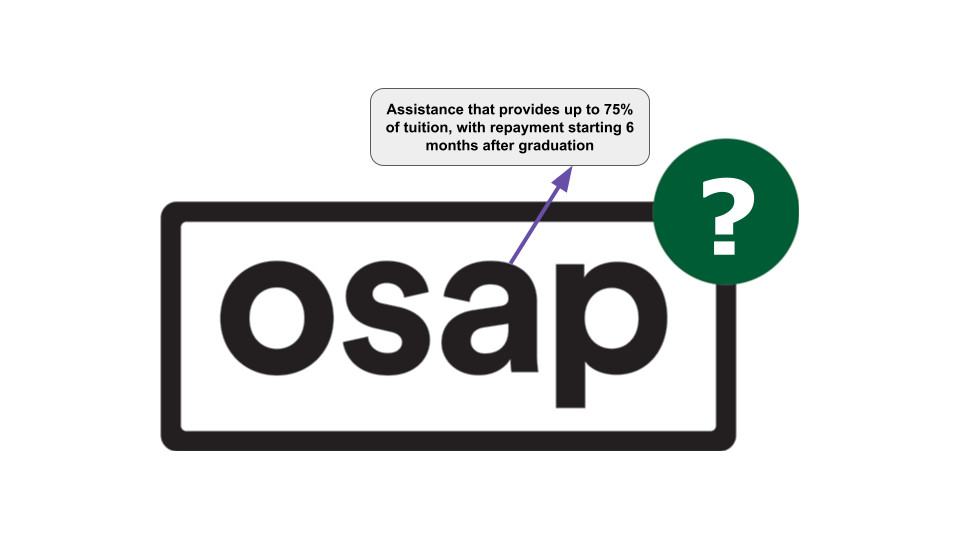
Students worry their debt will climb as financial aid shifts from grants to loans
Summary of article: Ontario’s Feb. 12, 2026 announcement reshaped student aid: domestic tuition can rise again and OSAP grants are slashed to a 25 per cent cap (minimum 75 per cent loans). The government adds C$6.4 billion over four years for colleges and universities. Wilfrid Laurier University students surveyed say these changes have heightened their financial stress, though the new funding may help institutions. Students note that shifting support from grants to loans could deter low-income students and leave graduates with more debt.
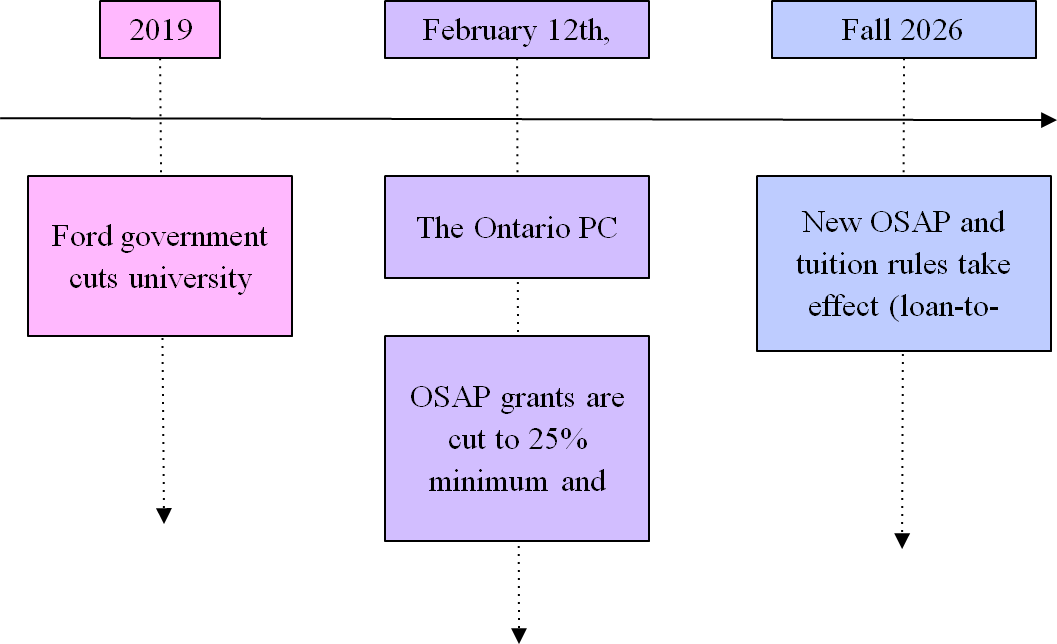
Premier Doug Ford’s government has ended Ontario’s college/university tuition freeze and overhauled the provincial student aid program. Effective September 2026, publicly assisted institutions may raise tuition by up to 2 per cent per year for three years (and following that, the lesser of up to 2 per cent or the average inflation rate of three years). At the same time, OSAP grants will be capped at 25 per cent of aid, with the rest as loans. In practice, a student who once could get $17,000 in free grants on a $20,000 OSAP package will now keep only $5,000. The changes were made “to align our student financial support framework with other jurisdictions,” Bianca Giacoboni, press secretary for Ontario’s Colleges and Universities Minister Nolan Quinn, said. According to Robert Williams, a reporter for the Waterloo Region Record and Allison Jones, a Queen’s Park correspondent for the Canadian Press, the government stated that OSAP funding was becoming “unsustainable,” because the total OSAP spending on grants jumped from $1.7 billion in 2024-25, a 143 per cent increase since 2020. Until 2017, the grant and loan ratio was 15 to 85 per cent, with then-premier Kathleen Wynne flipping the ratio late in her tenure.
For this fiscal year 2025-26, OSAP costs are expected to increase even further to $2.7 billion dollars. Based on provincial projections, that will jump to $3.7 billion in 2026-27, $4 billion in 2027-28 and $4.1 billion in 2028-29.
Wilfrid Laurier University students overwhelmingly agree education costs are rising faster than aid. In a recent survey of about 50 students, nearly all said they felt very concerned about affordability (22 marked “5” on a 5-point scale) and that post-secondary education is becoming less accessible. The top barriers cited were housing/food costs (14 students) and tuition fees (9 students), which were far above the other factors (academic pressures and lack of information about financial aid). As one third-year criminology student put it: “OSAP plays a huge role in whether higher education is financially manageable. When financial aid like OSAP is reduced, it creates a lot of uncertainty and pressure for students balancing school, work, and life.” Another fourth-year social work student warned that “graduates with higher debt will struggle, especially if they don’t find a job right away.”
Many Laurier students said the policy shifts would affect their planning. A second-year criminology & psychology student noted that cutting OSAP grants could force her to abandon a planned exchange program for lack of support. Another second-year health management student pointed out that the six‑month loan grace period is too short, especially for those pursuing advanced degrees. By contrast, one third-year history student said pragmatically that “loans are a reasonable form of student aid” and that their decision to attend university would not have changed.
Student organizations have largely criticized these changes. Sayak Sneddon-Ghosal, the president of the Ontario Undergraduate Student Alliance (OUSA), acknowledged the $6.4 billion boost to school funding, but also warned that “the continued shift within OSAP from grants to loans … risks disproportionately impacting students from various socio-economic backgrounds.”
The Ontario Nurses’ Association and nursing student groups have also voiced their concerns that higher education barriers could worsen expected nursing shortages. A Canadian study by Christine M. Neill found that increasing non-repayable aid (grants) significantly raises university enrollment, whereas simply expanding loans mainly affects whether students live independently, not overall participation. In short, a loan-heavy OSAP might deter some low-income youth from even applying to university.
Still, officials say students won’t lose total aid. An OSAP spokesperson noted that the Ontario Student Access Guarantee supports will remain to cover any gaps for underprivileged students. At Laurier, the Financial Aid Office directs students to scholarships and budgeting resources (see “Where to Get Help” below).
| Policy | Change |
| OSAP grants | Capped at 25% of aid (previously up to 85%) |
| OSAP loans | At least 75% of aid must be loans |
| Tuition increases | Allowed up to 2% per year (2026–2029); then ≤ 2% or inflation |
| Sector funding boost | +$6.4 billion over 4 years; annual operating funding → ~$7 billion |
When asked if there is anything they would like decision-makers to know about student concerns regarding education costs, students urged policymakers to consider the cost-of-living pressures. A fourth-year social work student commented, “Education costs are more than tuition – there’s rent, food, transport. OSAP helped cover those. Cuts make attending university feel out of reach for many.” A second-year political science student summed up their view, which was common among many students: “Going into more debt for school means we will be paying it off instead of investing in our future. Students should not be punished for wanting to learn.”
The new OSAP rules will not only affect current students, but also future OSAP applicants. Almost all students surveyed by the Laurier Student Poll Team (about 85 per cent) said they would still attend a post-secondary institution under the new system; however, many of them said they would reconsider their chosen program and/or school choices. For example, a third-year accounting student said they would “still enroll in university but maybe in a cheaper program or school,” if these changes had existed earlier. That student’s belief is also a reflection of a 2025 Ontario survey that found 79 per cent of OSAP recipients already expect their loan burdens to be very or somewhat high.
Additionally, Ontario’s announcement drew mixed reactions from university instructors. Some experts note that higher tuition income (from the 2 per cent hikes) can free government funds to bolster financial aid for underprivileged students. Others fear that any savings will come largely from students’ pockets. For instance, Glen Jones, the former dean of the Ontario Institute for Studies in Education, has called the OSAP grant-cut a “regressive policy,” saying wealthy families will barely notice, while poorer students pay thousands more. Meanwhile, organizations like the Canadian Federation of Students-Ontario urged students to protest the changes; rallies have taken place at Queen’s Park and campuses across the province.
Students seeking financial aid or debt advice can consult the Ontario Student Assistance Program (OSAP) overview and Laurier’s Financial Aid Office. Laurier Brantford also offers bursaries and counseling through Service Laurier, located at the front entrance of Grand River Hall. National resources include the Government of Canada student loans program and non-profit debt counselors. Students are encouraged to explore scholarships, part-time work programs and emergency aid funds to help assist with their finances.
Sources:
- Ontario Government Releases and Legislation: https://crdcn.ca/publication/the-effect-of-student-loan-limits-on-university-enrolments/
- Ontario Undergraduate Student Alliance: https://www.ousa.ca/pr_ousa_responds_feb_2026_announcement
- Nursing association press release: https://ona.org/news/20260309-cnsa-osap/
- University Affairs reporting: https://universityaffairs.ca/news/students-protest-cuts-to-osap-grants/
- The Eyeopener: https://theeyeopener.com/2026/02/students-shocked-after-ford-slashes-osap-grants-and-unfreezes-tuition/
- Laurier Financial Aid Office: https://students.wlu.ca/finances/financial-aid/index.html
- https://www.therecord.com/news/waterloo-region/osaps-multi-billion-dollar-dilemma/article_a76585e9-5f33-5f84-8402-91f076f107c6.html#:~:text=Under%20current%20premier%20Doug%20Ford,$4.1%20billion%20in%202028%2D29.
- https://halifax.citynews.ca/2026/03/04/students-protest-cuts-to-amount-of-osap-grants-they-can-receive/





Leave a Reply